


The Weight My Great-Grandfather Carried in WWII: The Legacy of Cheong Soo Long [張仕龍]

Updated: Nov 18, 2025
How One Man’s Silence Saved Lives During the Japanese Invasion.
.

I spent my childhood playing in the small village of Tjolok (Sungai Pinang), never imagining the history buried beneath those familiar roads. It was only through my mother’s stories, shared almost by accident, that I stumbled onto a chapter of courage and sacrifice that had lived in silence for decades. What I learned changed everything I thought I knew about that peaceful place and about the man whose blood runs in mine
During the Japanese invasion of Malaya, when fear ruled the land and people whispered rather than spoke, there lived a brave young man in the village of Tjolok (Sungai Pinang), Cheong Soo Long [張仕龍], my great-grandfather. He was one of twelve siblings, born into a modest family, growing up among rubber trees, unpaved roads, and the peaceful routine of village life. No one could have imagined that this gentle, humble man would one day carry the weight of lives on his back.

When war arrived in 1941, everything changed. Japanese soldiers patrolled the roads, arrested villagers without reason, and tortured anyone suspected of helping the British. It was during this darkness that wounded British soldiers began to appear in the hills, starving, bleeding, and lost. Some had bullet wounds. Some could not walk. Some lay in the mud, shivering from fever. Everyone knew the punishment for helping them: torture, death, or disappearance.
But humanity has a way of rising when fear tries to drown it. And among all the villagers, one man stepped forward when others stepped back.
One night, a badly injured British soldier was found barely alive near the rubber trees. Village leader Lin Ya-teck looked at the small group of men gathered in fear and turned to only one person: Cheong Soo Long [張仕龍], my great-grandfather. There were no words of persuasion, no promises, no hesitation. Soo Long simply nodded, walked forward, and lifted the soldier onto his shoulders. Despite his own fragile health, he stepped into the darkness with no lantern and only the sound of rain hitting the leaves. He carried the man deep into the forest to hide him from danger.
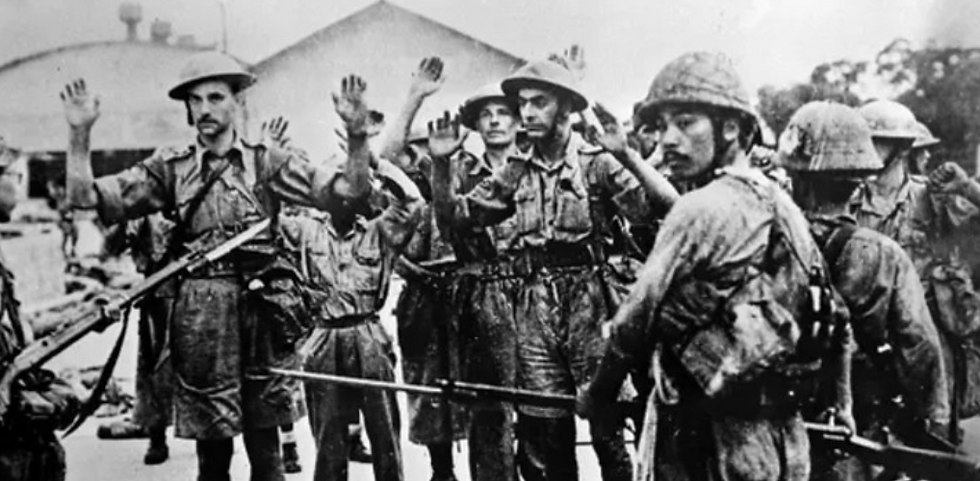
That night was only the beginning.
As days turned to months, and months turned to years, Soo Long [仕龍] made that same journey again and again. He carried food, water, clothing, and hope into the jungle. He walked in storms that turned the ground to mud. He climbed slippery hills with rice tied to his back. Some nights, he traveled with his younger brother, just thirteen years old, who carried bags of rice nearly as big as himself. Their mother cried each time they left the house, knowing they might never return.
But Soo Long [仕龍] went anyway. The soldiers he saved were weak from hunger. Some had lost the ability to stand. Soo Long [仕龍] knelt beside them, lifted them with his arms, and carried them across streams and slopes as if they were family. British aircraft sometimes dropped medical supplies and food into the forest, and he would rush out under gunfire to retrieve them. On the days when the Japanese patrolled too closely, Soo Long [仕龍] hid the soldiers under leaves and branches and waited beside them in silence, heartbeat steady, breath controlled, ready to take the blame if discovered.
He carried life with strength, while others carried fear. He did it fully, silently, without complaint, but danger grew in another form.
A villager named Kiau Hoo, who once helped, eventually betrayed the rescue effort to the Japanese. He followed Soo Long [仕龍] and the others on a rainy day, watched them deliver food, and later reported everything. His betrayal exposed the hidden British soldiers and the men who risked their lives to save them. Within days, Japanese forces raided Tjolok. British soldiers were captured. And the rescuers were hunted.

In 1943, they came for my great-grandpa.
When he was dragged away, his siblings cried out, his mother begged the soldiers to stop, and his younger brother watched helplessly as the man he admired most was taken toward the torture chambers. Soo Long [仕龍] did not look back. He walked with the same steady steps he used in the forest as if he had already made peace with what awaited him.
Inside the Japanese prison, the interrogators demanded names.
Who helped you?
Who carried the food?
Who hid the soldiers?
Where are the others?
He said nothing.
So they beat him.
They tied him to racks.
They burned him with hot metal rods.
They struck his legs until he could not stand.
They poured water into his mouth until he could not breathe.
He fainted from pain, woke up, and suffered again.
Still, he kept silent.
His older brother later said:
"If Soo Long [仕龍] had spoken, at least ten to seventeen villagers would have been arrested."
He endured the torture so others could live. His silence protected families, neighbors, children, and an entire community. The torture broke his body, but never his spirit.
In 1944, too weak to stand and too wounded to recover, your great-grandfather took his final breath in a cold prison cell. He died young, but he died with courage intact, protecting everyone he loved.
After the Japanese surrendered, the surviving British soldiers returned to Tjolok (Sungai Pinang). Only one of the soldiers my great-grandfather carried through the hills lived to come back and thank the family. When he found the Cheong family, he bowed deeply, tears in his eyes, and said:
"Your father saved us. We owe him our lives."
He never lived to hear those words. But they are the truths that have been carried across generations. And though I never met him, never heard his voice, and grew up never knowing his name, I feel him now, deeply, unexpectedly, powerfully. His story found me the way truth always finds those who are meant to carry it.
In learning who he was, I began to understand who I am. I look at his courage, his impossible strength, his brave heart, and I am proud, so proud to carry even a small piece of his DNA, proud to belong to the lineage of a man who chose humanity over fear. His story is not just history; it is a mirror, reminding me that bravery can live silently inside us until the moment it is needed. This story must be shared with the world, but most importantly, with his children, his grandchildren, his great-grandchildren, and the great-great-grandchild who carries his blood today. May they all know the truth of the man they come from, and may his courage continue to live on through us. **A Voice From His Children
Many decades later, one of Cheong Soo Long's children, who was only two years old when he died, shared what life was like after he was taken from them. Her memories are blurry at the edges, shaped mostly by the stories passed down from those who witnessed the cruelty of war.

"According to my mother, my father, Cheong Soo Long, was taken away by the Japanese army and tortured to death at the age of 30. At that time, I was only 2 years old. Our family lived in the small village of Sungai Pinang.
When the Japanese invaded in 1941, more than 40 villagers fled into the jungle. The soldiers promised they would be spared if they surrendered, but after the villagers returned, the Japanese arrested more than a dozen people, including my father.
They were all tortured. Some were beaten while hanging upside down from trees. Others were forced to drink the 'red medicine,' a poisonous liquid that killed many. My uncle survived, and he later told us the captured villagers suffered unimaginable pain. Even though my father was young and strong, he could not escape death.
My mother was only 28 years old, left alone with three young children. Life became extremely difficult. Whenever we passed the place where my father died, my uncle would recall those dark times. He held back tears as he described how brutally the Japanese treated my father and the villagers. Those memories stayed with him until the end of his life. Because I was so young, I could not remember my father's face clearly.
All I remember are my mother's tears. She was widowed very young and had to raise us alone, a life full of hardship. Yet she never forgot to teach us to be strong, and to never give up on life. In recent years, every November 11, our family gathers to lay flowers at the memorial monument and pay our respects. It is not only for my father, but for the thousands of innocent people who died during the Japanese occupation.
"History can be forgiven, but it must never be forgotten." - Cheong Kim Choo.
This testimony is not only a memory, it is a bridge connecting the generations who lived through war and pain to those of us who now live in peace. It is a reminder that every act of courage echoes across a family line, shaping lives long after the hero is gone.
**A Glimpse Into His Roots: The Woman Who Raised Him**

Including her photo honors not only the heroism of Soo Long, but also the quiet endurance of the woman who raised him, a mother whose strength became the foundation of his courage.
**A Second Pillar of Strength: The Woman Who Carried the Family Forward

Though this story is about Cheong Soo Long’s courage during the war, it is also about the woman who held the family together after he was gone. When her husband was taken and killed at just thirty years old, my great-grandma was suddenly widowed with six young children depending entirely on her.
There was no compensation, no safety net, no rest. Only grief… and responsibility.
Yet she rose to both.
She worked tirelessly, often sacrificing her own needs so her children could survive. Through poverty, fear, and years of uncertainty, she taught them to be strong, to stay united, and to never give up on life. Her endurance gave her children a future. Her resilience shaped the generations that followed.
To tell Soo Long’s story without her would leave it incomplete. She is the quiet counterpart to his heroism, the strength that carried his legacy forward long after his death.
Her photo belongs here not only as a remembrance, but also as recognition of her role as a mother, a widow, and a woman who stood unshaken through unimaginable hardship.
To my great-grandfather, Cheong Soo Long:
"Your courage survived the war even when your body did not. Your silence saved lives. Your sacrifice protected a village. And your legacy now lives through the hearts of those who never knew your face, but carry your blood.
This story is dedicated to your children, your grandchildren, your great-grandchildren, and the great-great-grandchild who carries your name forward. May we remember you not only as a name in our family tree, but also as the quiet hero whose strength runs through every generation that followed you.
This story is for you. This memory is for you. This love is for you. May your courage live on through us."
With all my love,
The great-granddaughter whose life you touched without ever meeting her.
Credits & Sources
This story was lovingly rebuilt from three precious sources:
• A historical account preserved in the book "记者生涯三十年 (Thirty Years of a Journalist's Life)" by Han Kok Foo, which documented the bravery of the villagers of Tjolok during the Japanese occupation. Eight thousand copies were printed in 1978 and 1979.
• Stories shared by my mother, who carried fragments of our family history across time, passing them down with tenderness and truth.
• Memories from my 5th great-aunt, who offered missing pieces, recollections, personal moments, and firsthand echoes of a life lived in courage.
Together, these threads allowed me to rediscover the life of my great-grandfather, Cheong Soo Long [張仕龍], and weave his legacy into a story that now belongs to all of us.
You didn't write all of that to fall on deaf ears. ;) The version I originally saw was all in Japanese. Band-Maid is my favorite band, so translating it wasn't too hard. You always write from your heart... Again, another amazing read. I clicked again and something changed, it is now in English. I enjoyed reading both. My grandfather had quite the story in the 'big war' also. Yours is a much better story...